6th-Grade ELA Assignment


Overview
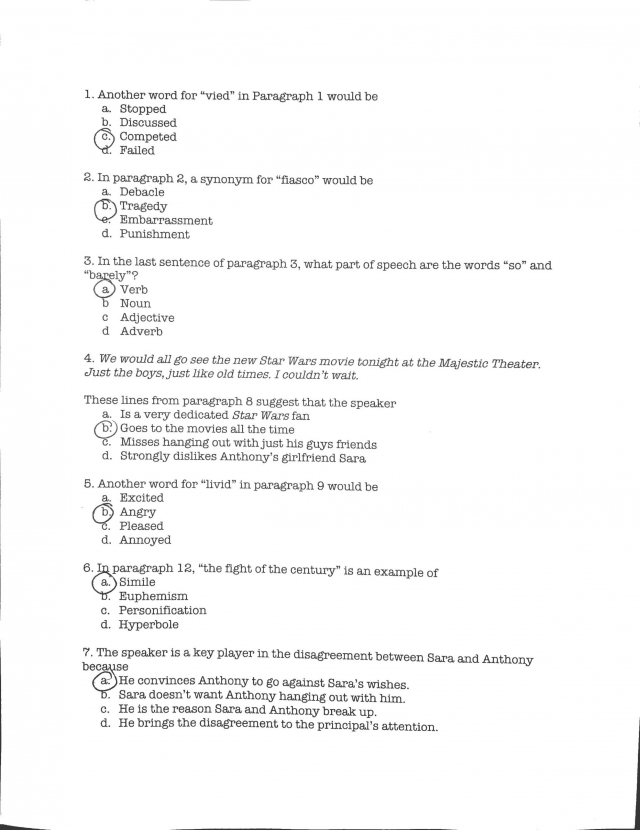
Sixth-grade students read a short fiction story about a conflict among students and then answer multiple-choice questions about the text. The assignment is weak because the text is significantly below grade level and does not build meaningful content or cultural knowledge for students. In addition, most of the questions do not require close reading or evidence-based responses.
About the Text
Title
“Trouble at School”
What is the Lexile Level of this text?
Based on Lexile, which grades is this text intended for?
Is the text qualitatively complex enough for the grade?
Is this text fiction or non-fiction?
Is this text authentic or was it written for educational purposes?
Does the text provide sufficient detail to build knowledge of a worthwhile topic and/or is it worth reading closely and re-reading?
Why is this assignment weakly aligned?
It doesn’t use a worthwhile, grade-level text. This text doesn’t build knowledge and does not approach the skillful craft and literary merit we would hope to see in sixth grade. While students might have a personal connection to the characters or events, they are unlikely to gain new knowledge or build new vocabulary from reading the text.
The questions asked do not align to the sixth-grade reading standards. In sixth grade, students are expected to engage in deep analysis of a worthwhile text. In this assignment, they are only asked to define words and perform basic recall-and-restatement of events from the text.
The questions asked do not align to the sixth-grade language standards. While some questions allow students to use context to determine the meaning of vocabulary words (L.6.4A), the words themselves are too low-level and likely don’t require close reading. One question covers figurative language (L.6.5A), but it asks students to label the type of figurative language, rather than asking them to interpret the language in context. Lastly, one question attends to language conventions (L.6.1), but it asks about parts of speech, which is more closely aligned to second-grade standard L.2.1.E.